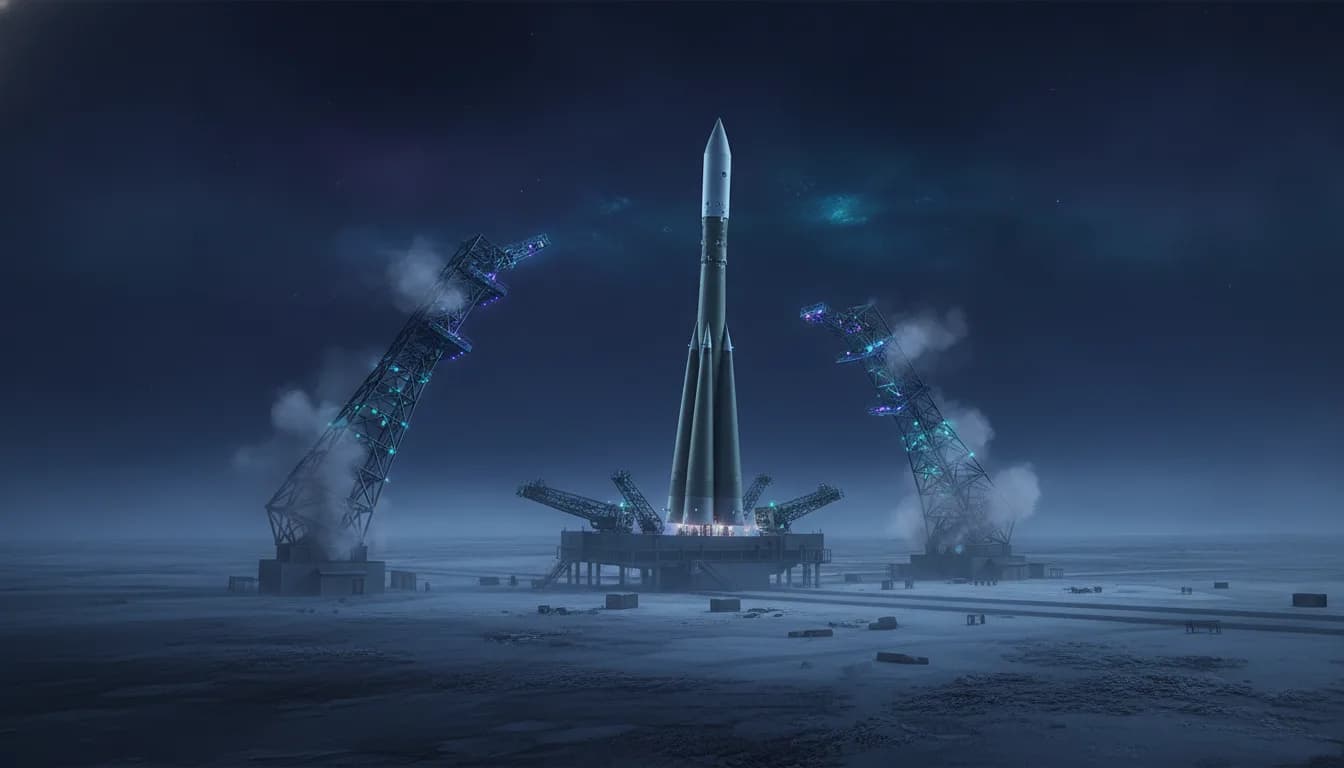
Soyuz-2.1b
OperationalRKTs Progress · Russia · First flight 2006
The most capable member of the Soyuz-2 family, derived from the R-7, the most launched rocket design in history. Adds the RD-0124 third-stage engine. Flies Glonass navigation satellites, military and Earth-observation payloads and some Progress cargo flights, and launched Luna 25 in 2023; crewed Soyuz flights use the Soyuz-2.1a. Counts here exclude Soyuz ST-B flights from Kourou.
Launch price
Not published
Payload to LEO
8,670 kg
3,250 kg to GTO
Career record
97.7%
85/87 successful · as of 2026-10-09
Next launch
Nov 24, 2026
Progress MS-36 (97P)
Want to choose exactly what you get? Build your own launch alert, free with an account: GO, liftoff, success, partial failure or failure, time changes, holds and scrubs, and reminders a day, an hour and ten minutes (push) before launches with an exact time, filtered by rocket, launch site, provider, crewed flights or Moon missions.
Subscribe in your calendar (every Soyuz-2.1b launch): Apple or OutlookGoogleDownload .icsCalendar entries move when launch times move. A launch known only to the month appears once it has a day.
More launch calendarsLaunch activity, live
From SpaceNexus's launch tracker (tracked since Nov 21, 2024); outcomes recorded as each flight lands. Career totals above are the vehicle's full history.
Last 90 days
4
launches flown
Tracked flights
28
28 success · 0 partial · 0 failed
Tracked success rate
100%
full successes / attempts; partial failures are not successes
On the manifest
5
upcoming launches
Upcoming
Specifications
| Height | 46.3 m |
| Diameter | 2.95 m |
| Liftoff mass | 312,000 kg |
| Stages | 3 |
| Engines | 4x RD-107A + 1x RD-108A + 1x RD-0124 |
| Propellant | RP-1 / LOX |
| Fairing diameter | 4.11 m |
| Payload to LEO | 8,670 kg |
| Payload to GTO | 3,250 kg |
| Payload to SSO | 4,400 kg |
| Reusable | No |
| First flight | 2006-12-27 |
| Last flight | Active |
| Variants seen on the manifest | Soyuz 2.1a, Soyuz 2.1a Fregat-M, Soyuz 2.1b, Soyuz 2.1b Fregat, Soyuz 2.1b Fregat-M, Soyuz 2.1b Volga, Soyuz 2.1v Volga |
Where it launches from
Frequently asked
How much does a Soyuz-2.1b launch cost?
RKTs Progress has not published a list price for Soyuz-2.1b.
When is the next Soyuz-2.1b launch?
The next tracked Soyuz-2.1b launch is Progress MS-36 (97P), Nov 24, 2026 from Baikonur Cosmodrome, Republic of Kazakhstan. Dates move; Mission Control carries the live countdown.
How reliable is Soyuz-2.1b?
Soyuz-2.1b has flown 87 times as of 2026-10-09, with 85 successes, 2 failures and 0 partial failures: a 97.7% success rate, with 63 consecutive successes at last count.
How much can Soyuz-2.1b carry?
8,670 kg to low Earth orbit, 3,250 kg to geostationary transfer orbit, 4,400 kg to sun-synchronous orbit.