
The short answer
Artemis III is planned for 2027, and it is not a Moon landing. NASA restructured the mission in February 2026: instead of flying to the Moon, Orion and a crew of four will spend about two weeks in low Earth orbit rehearsing the one thing the programme has never done: rendezvous and docking between Orion and the commercial landers that will carry astronauts to the surface. It docks first with a Blue Origin Blue Moon Mark 2 pathfinder, then with a SpaceX Starship HLS pathfinder, then comes home.
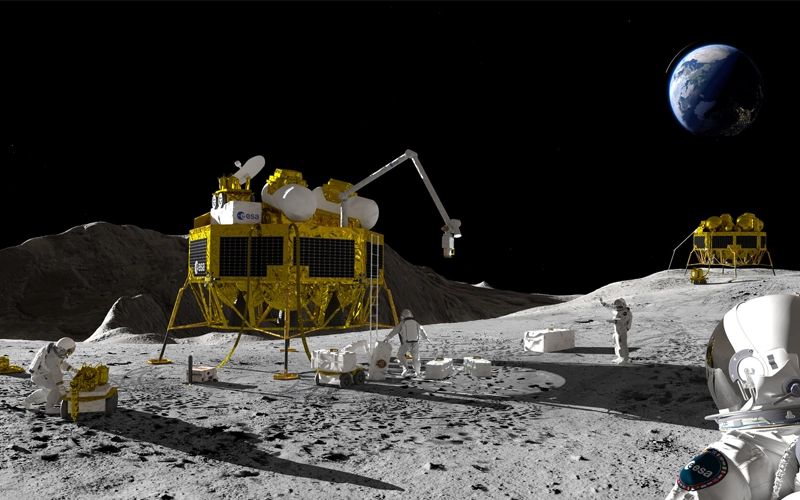
The landing that Artemis III was originally going to be now belongs to Artemis IV, planned for 2028: two of its four astronauts descend to the lunar south pole region, the first human steps on the Moon since December 1972. NASA has not yet chosen the lander; it says readiness will decide between SpaceX's Starship and Blue Origin's Blue Moon. NASA has not set an exact date for either mission; both are year-level targets that depend on the hardware milestones listed further down.
What changed in February 2026
The original Artemis III plan, announced years ago and repeated in countless articles that are still online, was a crewed lunar landing using SpaceX's Starship as the lander. Two things made that untenable on the old schedule. The landers were not going to be ready for crew, and Orion had never docked with anything: neither Artemis I nor Artemis II carried a docking system, so the first Orion-to-lander docking would have happened in lunar orbit, on the mission that depended on it, with astronauts aboard.
NASA's answer was to split the risk. Artemis III became an Earth-orbit demonstration where an abort is a deorbit burn and a splashdown rather than a multi-day return from the Moon, and the landing moved to Artemis IV with a rehearsal already behind it. That is the same logic Apollo used: Apollo 9 tested the lunar module in Earth orbit before Apollo 10 and 11 took it to the Moon.
The practical effect for anyone following the programme: a page that says “Artemis III will land astronauts on the Moon” without a February 2026 caveat is describing a plan that no longer exists.
The crew
Named by NASA on June 9, 2026. Bob Hines (NASA) is the backup.
Parmitano is the first ESA astronaut assigned to an Artemis mission, and the first Artemis pilot from outside NASA, reflecting ESA's contribution of Orion's service module. (Canada's Jeremy Hansen flew on Artemis II as a mission specialist.) Bresnik and Rubio are both long-duration ISS veterans; Rubio holds the US single-flight duration record from his unplanned year-long stay in 2022-23.
The mission, step by step
- Launch. The Space Launch System lifts Orion and its four-person crew from Launch Complex 39B at Kennedy Space Center into low Earth orbit.
- Checkout. Orion runs systems checkouts in orbit: life support, navigation, communications and the docking system it has never used with a crew aboard.
- First docking: Blue Origin. Orion performs a first-ever rendezvous and docking with a Blue Moon Mark 2 human landing system pathfinder, and stays docked for about two days of joint operations.
- Second docking: SpaceX. After separating, Orion rendezvous and docks with a Starship human landing system pathfinder for roughly a day of docked operations.
- Return. Orion undocks, deorbits and splashes down in the Pacific. NASA expects roughly two weeks in total, with the exact length set in real time by how the rendezvous and docked operations go.
What has to happen first
The milestones NASA itself lists, plus the one that sits with the contractors. Any of these slipping moves the launch.
The Artemis III crew module and the ESA-built service module were joined at Kennedy by August 5, 2026 (NASA); integration continues.
The hardware that makes this mission possible: Orion has flown twice but has never docked with anything.
The heat shield was the focus of post-Artemis-I scrutiny; Artemis II flew the updated approach successfully in April 2026.
The core stage reached Kennedy on April 27, 2026. Booster segment stacking began in early July and was more than halfway done by August 27; RS-25 engine installation began in late August (NASA).
Both companies must deliver dockable vehicles to orbit on their own rockets (New Glenn and Starship respectively) ahead of Orion's launch. Starship first reached orbit on Flight 14, a Starlink flight, on September 28, 2026, SpaceX reported; no HLS pathfinder has flown yet, and New Glenn's return to flight after a May 28 pad explosion was targeted for the end of 2026.
The Artemis tracker keeps these milestones current alongside the full programme timeline.
So when do humans land on the Moon?
Artemis IV, 2028, on NASA's current plan (its target is early 2028). Four astronauts ride Orion to lunar orbit; two transfer to a commercial lander, descend to the south polar region, and return the same way. Which lander is not yet decided: NASA says “lander readiness will determine which provider” carries the crew. Gateway, the lunar-orbit station earlier plans had Artemis IV visit, was paused by NASA on March 24, 2026.
Two things gate that date beyond Artemis III itself: the chosen lander must fly an uncrewed demonstration landing on the Moon first, and for Starship that follows the in-orbit, ship-to-ship propellant transfer a lunar mission requires, which was planned for March 2026 and still had not been attempted as of September 2026. Both are tracked on our Starship tracker. Anyone quoting a 2028 landing as settled is ahead of the hardware.
China is working toward a crewed landing of its own. Our US vs China Race to the Moon tracker compares the two programmes rung by rung: demonstrated hardware, projected landing windows and every source. China's side, with its official wording, is on the China Moon landing plan page, and every dated step for both countries is on the Moon landing timeline.
Starship HLS and Blue Moon
NASA deliberately bought two landers. SpaceX's Starship HLS won the first contract in April 2021 ($2.89 billion), for the landing then planned for Artemis III; it is a lunar variant of the Starship upper stage, refuelled in Earth orbit by tanker flights before departing for the Moon. Blue Origin's Blue Moon Mk2 was added in May 2023 ($3.4 billion) as a second supplier, launched on New Glenn, so the programme never again depends on one company for surface access. For Artemis IV, NASA says lander readiness will decide which of the two flies the crew.
Artemis III tests docking with pathfinder versions of both. Which flies, and in what order, is itself a status signal for the two programmes; our Blue Origin vs SpaceX guide follows both companies' progress with live launch data.
Latest Artemis news (live)
 missions


 launches
Artemis III FAQ
When will Artemis III land on the Moon?
It will not. As of 11 Oct 2026, Artemis III is a crewed docking test with lander pathfinders in Earth orbit, dated 2027 (NASA has said mid to late 2027), and not a landing. The first crewed landing since 1972 is Artemis IV, dated 2028 (NASA target: early 2028).
When is Artemis III launching?
NASA's current plan is 2027. Its March 2026 architecture update put the target at mid-2027, and in April the Administrator told Congress of a late-2027 rendezvous; NASA's mission page, updated October 6, 2026, says only 2027. It has not published a specific date; its June 9, 2026 crew announcement says the mission will "undertake a series of challenging tests in Earth orbit in 2027." Treat any exact date you see elsewhere as speculation until NASA sets one.
Is Artemis III landing on the Moon?
No. In February 2026 NASA restructured Artemis III from a lunar landing into an Earth-orbit demonstration: Orion will rendezvous and dock with the commercial landers from Blue Origin and SpaceX in low Earth orbit. The first crewed landing since Apollo 17 is now planned for Artemis IV.
Why was Artemis III changed?
Because the landers were not going to be ready for a crewed lunar landing on the original schedule, and rendezvous and docking between Orion and a lander had never been demonstrated. Rehearsing those operations in Earth orbit, where an abort is a deorbit burn rather than a multi-day return from the Moon, retires the riskiest unknowns before a landing depends on them.
Who is on the Artemis III crew?
Commander Randy Bresnik (NASA), Pilot Luca Parmitano (ESA), and Mission Specialists Andre Douglas and Frank Rubio (both NASA), announced June 9, 2026. Bob Hines (NASA) is the backup. Parmitano is the first ESA astronaut assigned to an Artemis mission, according to NASA; Canada's Jeremy Hansen had already flown on Artemis II as a mission specialist.
How long is the Artemis III mission?
About two weeks, according to NASA, with the precise duration decided during the flight based on the launch, the rendezvous and how long the docked operations take.
Where does Artemis III launch from?
Kennedy Space Center in Florida, on the Space Launch System rocket, the same pad and vehicle as Artemis I and II. Our Cape Canaveral launch guide covers how to watch a launch from the Space Coast.
Does Artemis III go to the Moon at all?
No. It stays in low Earth orbit for the whole mission. Artemis II, which flew in April 2026, was the crewed lunar flyby; Artemis III tests the landers in Earth orbit; Artemis IV goes back to the Moon to land.
When will NASA land astronauts on the Moon?
Artemis IV, planned for 2028 (NASA's target is early 2028), is the first crewed landing, near the lunar south pole: four astronauts fly to lunar orbit and two descend. That date depends on Artemis III going well and on the chosen lander completing an uncrewed lunar landing demonstration first.
Which lander will be used for the landing?
NASA has not decided. Its March 2026 architecture update says "lander readiness will determine which provider" carries the Artemis IV crew: SpaceX's Starship HLS or Blue Origin's Blue Moon Mark 2. SpaceX won the first lander contract in 2021 and an option in 2022 that together covered the landings then planned for Artemis III and IV; Blue Origin was added as a second supplier in 2023. Artemis III tests docking with pathfinder versions of both.
Did Artemis II succeed?
Yes. Artemis II flew April 1-10, 2026 (US Eastern time; splashdown was at 00:07 UTC on April 11) with Reid Wiseman, Victor Glover, Christina Koch and Jeremy Hansen, the first crewed flight beyond low Earth orbit since 1972. On April 6 the crew reached 252,756 miles from Earth, a new record for humans (NASA). Our Artemis II live-blog archive has the full mission record.
Is the Lunar Gateway part of Artemis III?
No. The restructured Artemis III stays in Earth orbit. NASA also paused Gateway, the planned lunar-orbit station, on March 24, 2026 and plans to repurpose applicable hardware (GAO); no Artemis mission is currently planned to dock with it.
Could Artemis III slip past 2027?
It could; every Artemis mission so far has moved. The prerequisites section of this page lists what has to be finished first (Orion integration, SLS stacking, and both companies delivering dockable test vehicles), and the live news rail below will show any change the day it is announced.
Keep going
- Artemis programme tracker: every mission, every milestone, live news.
- Artemis II live-blog archive: the April 2026 lunar flyby, as it happened.
- Starship tracker: the lander's progress.
- Watch a launch from Cape Canaveral: where Artemis III lifts off.
Sources: NASA's Artemis III mission page; NASA release 26-022 (February 27, 2026) and its March 3, 2026 architecture update; NASA's May 13 and June 9, 2026 Artemis III releases; NASA Artemis II flight-day blogs; NASA OIG IG-26-004; GAO-26-108556. Dates are NASA's stated year-level targets, not launch dates; this page is updated when NASA updates them. Fact-checked September 23, 2026; rechecked October 11, 2026.