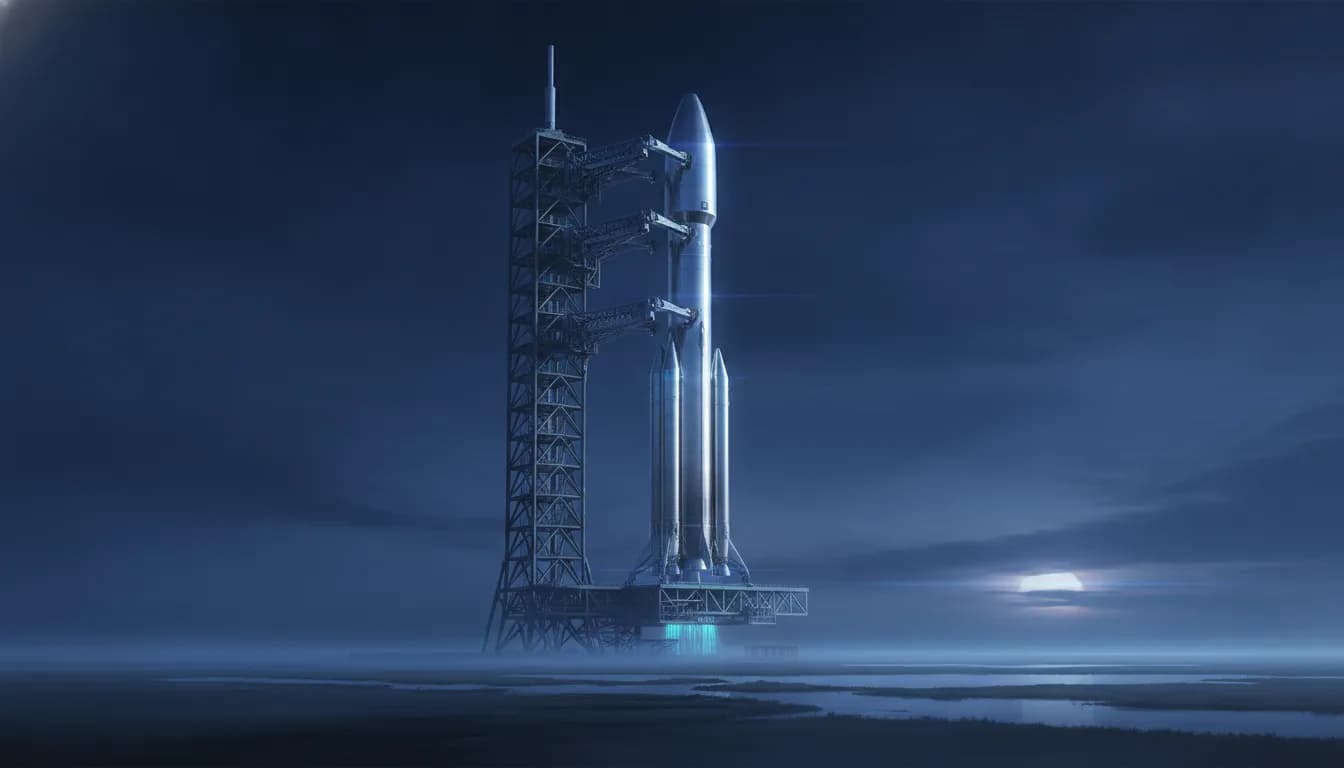
Starship / Super Heavy
In DevelopmentSpaceX · United States · First flight 2023 · Reusable first stage
The largest and most powerful rocket ever flown, designed for full and rapid reusability; SpaceX says it is designed to carry more than 100 metric tons to orbit fully reused. Still in flight testing: its first 13 test flights (April 2023 to July 2026) flew suborbital trajectories; Flight 13 (July 24, 2026) deployed 20 Starlink V3 satellites on a suborbital path where they reentered by design. On Flight 14, September 28, 2026, Starship reached orbit for the first time, deployed 26 Starlink V3 satellites and splashed down in the Pacific after a deorbit burn, SpaceX reported; the booster splashed down in the Gulf of America, with no catch planned. The cost figures shown are a long-run goal stated by Elon Musk for mature flight rates: a target, not an offered price. Intended to also enable Mars missions, point-to-point Earth transport, and a much lower cost per kg to orbit. See live launch data for current flight-rate and reliability figures rather than a fixed count here.
Launch price
Not published
Payload to LEO
100,000 kg
Career record
No counted launches yet
14 test flights as of 2026-09-28, not counted as launches
Next launch
NET Q4 2026
Flight 15
Want to choose exactly what you get? Build your own launch alert, free with an account: GO, liftoff, success, partial failure or failure, time changes, holds and scrubs, and reminders a day, an hour and ten minutes (push) before launches with an exact time, filtered by rocket, launch site, provider, crewed flights or Moon missions.
Subscribe in your calendar (every Starship launch): Apple or OutlookGoogleDownload .icsCalendar entries move when launch times move. A launch known only to the month appears once it has a day.
Launch activity, live
From SpaceNexus's launch tracker (tracked since Nov 19, 2024); outcomes recorded as each flight lands. Career totals above are the vehicle's full history.
Last 90 days
2
launches flown
Tracked flights
9
6 success · 0 partial · 3 failed
Tracked success rate
66.7%
full successes / attempts; partial failures are not successes
On the manifest
4
upcoming launches
Upcoming
Specifications
| Height | 124 m |
| Diameter | 9 m |
| Stages | 2 |
| Engines | 33x Raptor (booster) + 6x Raptor (ship) |
| Propellant | CH4 / LOX (Methalox) |
| Payload to LEO | 100,000 kg |
| Reusable | Yes (first stage) |
| First flight | 2023-04-20 |
| Last flight | – |
| Variants seen on the manifest | Starship, Starship V1, Starship V2, Starship V3 |
Where it launches from
Frequently asked
How much does a Starship / Super Heavy launch cost?
SpaceX has not published a list price for Starship / Super Heavy.
When is the next Starship / Super Heavy launch?
The next tracked Starship / Super Heavy launch is Flight 15, NET Q4 2026 from SpaceX Starbase, TX, USA. Dates move; Mission Control carries the live countdown.
How reliable is Starship / Super Heavy?
Starship / Super Heavy has no counted launches yet as of 2026-10-09, so it has no career success rate. It had flown 14 test flights as of 2026-09-28; test flights are not counted as launches. The tracked flights below come from SpaceNexus's launch tracker.
How much can Starship / Super Heavy carry?
100,000 kg to low Earth orbit.
Status
developmentas of 2026-09-28
In flight testing: 14 test flights since April 2023. The first 13 flew suborbital trajectories; on Flight 14, September 28, 2026, Starship reached orbit for the first time and deployed 26 Starlink V3 satellites, SpaceX reported.
- 2025-08-26Flight 10: first payload deployment, eight Starlink simulators on a suborbital path.
- 2026-05-22Flight 12: first flight of the V3 ship and booster and of Raptor 3, and the first launch from Pad 2.
- 2026-07-24Flight 13 (suborbital): deployed 20 Starlink V3 satellites on a path where they reentered by design about 20 minutes after release; the ship splashed down intact in the Indian Ocean; the booster made a hard splashdown in the Gulf.
- 2026-09-28Flight 14: first orbital flight of Starship, per SpaceX. The ship entered orbit, deployed all 26 Starlink V3 satellites (all in contact, SpaceX said), deorbited after about 3 hours in orbit (the plan was nearly 10 hours) and splashed down in the Pacific; the booster splashed down in the Gulf of America. No catch was planned.
Next: Ship-to-ship propellant transfer in orbit, which NASA's Starship lander depends on, has not been attempted; catching the ship at the tower has not been attempted either.
Sources: SpaceX Flight 5, 9, 10, 12, 13 and 14 mission pages (spacex.com/launches) · SpacePolicyOnline, 2026-07-25 (IFT-13) · Spaceflight Now, 2026-09-23 (Flight 14 stacked) · SpaceX on X, 2026-09-28 (Flight 14 orbit, deployment, deorbit and splashdown posts)
Public commitments
On the Promise Ledger: 4 entries: 1 met; 1 missed; 1 revised; 1 pending. Exact words, primary sources, deadlines and outcomes.
- First uncrewed Starships launch to Mars in the 2026 window
- Starship begins delivering payloads to orbit in the second half of 2026
- Four Mars ships in 2024, two cargo and two crew
- dearMoon: first private passenger flight around the Moon in 2023
What the statuses mean
- Met:
- happened on or before the deadline.
- Missed:
- the deadline passed without it (confirmed).
- Revised:
- the date or quantity was moved before it came due.
- Pending:
- the deadline has not passed.
The whole Promise Ledger · same rules for everyone, how entries are scored